
A common question among newcomers is:
“Will wet cupping damage my blood vessels?”
The short answer is no — not when performed correctly by a trained practitioner. Let’s break down the simple science behind why wet cupping (Hijama) is actually gentle and safe for your skin and blood vessels.
Wet Cupping Works Only on the Surface of the Skin
lancet never reaches your main blood vessels or muscles
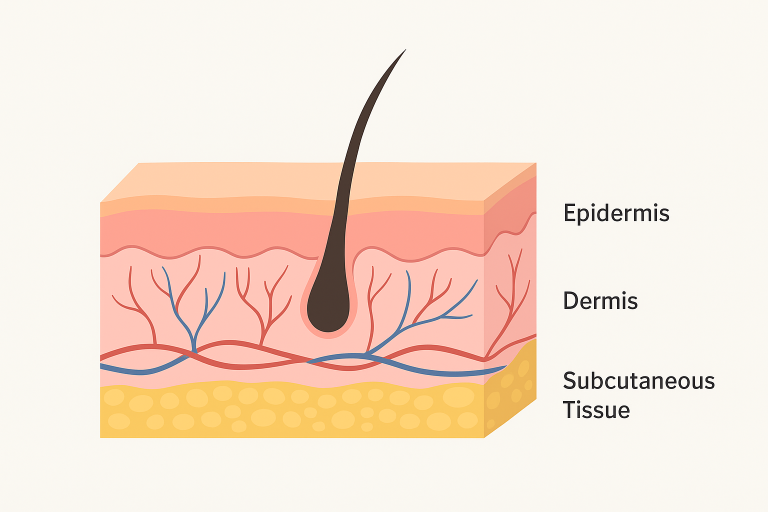
Your skin has three main layers:
- Epidermis — the thin outer layer (about 0.1–0.2 mm thick).
- Dermis — the middle layer (1–2 mm thick), where tiny blood vessels called capillaries live.
- Subcutaneous layer — the deeper fatty layer where larger vessels and nerves begin.
Wet cupping works only on the upper and middle layers — never deeper. The tiny scratches made are around 0.3–0.5 millimeters deep, thinner than a bank card. That means the lancet never reaches your main blood vessels or muscles. Instead, it targets the fine network of superficial capillaries, which safely release a small amount of blood and quickly heal.
Scientific studies confirm that this mild stimulation activates local circulation and tissue repair — without damaging deeper structures (Lee et al., 2017; AlBedah et al., 2019).
Which Blood Vessels Are Actually Involved?
Wet cupping affects only superficial capillaries
The smallest blood vessels in the body, just 0.008 mm wide. When they open slightly, your body repairs them almost immediately, just like when you get a small scratch or mosquito bite. So rather than “damaging” vessels, wet cupping gently opens micro-channels for better blood flow and detoxification. Arteries and veins — which lie much deeper — remain completely untouched.
In short: wet cupping opens the surface capillaries to refresh circulation, not harm them.
The Suction Is Gentle and Controlled
Vacuum pressure only enough to bring blood to surface, but not enough to tear tissues
Another reason for its safety is the negative pressure used during cupping. Typically, the vacuum pressure is around –200 to –300 mmHg — strong enough to bring blood to the surface, but not strong enough to tear tissues.
Think of it like a gentle vacuum massage: it clears blocked micro-capillaries and boosts local circulation without any internal damage.
Your Body Naturally Repairs and Strengthens the Area
Activate Repair Process
When the skin is lightly scratched, your body immediately activates a natural repair process:
- Fresh oxygen-rich blood rushes to the area.
- The immune system cleans out old or damaged cells.
- New skin cells and collagen are formed.
This is your body’s built-in healing mechanism — and wet cupping simply encourages that process.
That’s why afterward, the skin feels warm, relaxed, and renewed — never harmed
It Never Touches Deep Muscles or Vital Organs
Far from vital structure, only within the upper skin layer
Because wet cupping works only on the surface, it doesn’t reach or affect:
- Deep muscles
- Large arteries or veins
- Major nerves
- Internal organs
When performed on standard safe zones (like the back, neck, or shoulders), it stays completely within the upper skin layers — far from any vital structures.
The Amount of Blood Released Is Very Small
superficial micro-injury — safe, self-healing, and low-risk.
During a session, only a tiny amount of blood is released — usually 2–5 milliliters per cup, less than a teaspoon. That’s far less than what comes from a small nosebleed or a blood test.
This mild release helps the body refresh old blood cells and stimulate better circulation — without causing weakness or anemia. For perspective:
- A kitchen cut is about 1–2 mm deep.
- A wet cupping scratch is less than 0.5 mm deep.
- Medically, that’s called a superficial micro-injury — safe, self-healing, and low-risk.
Summary
Wet cupping (Hijama) doesn’t harm blood vessels — it helps them reset. By targeting only the uppermost capillaries, it boosts circulation, supports detoxification, and encourages natural healing — all without damaging deep tissues.