
For many beginners learning wet cupping, one question appears again and again:
“Should I use a lancing device or a scalpel?”
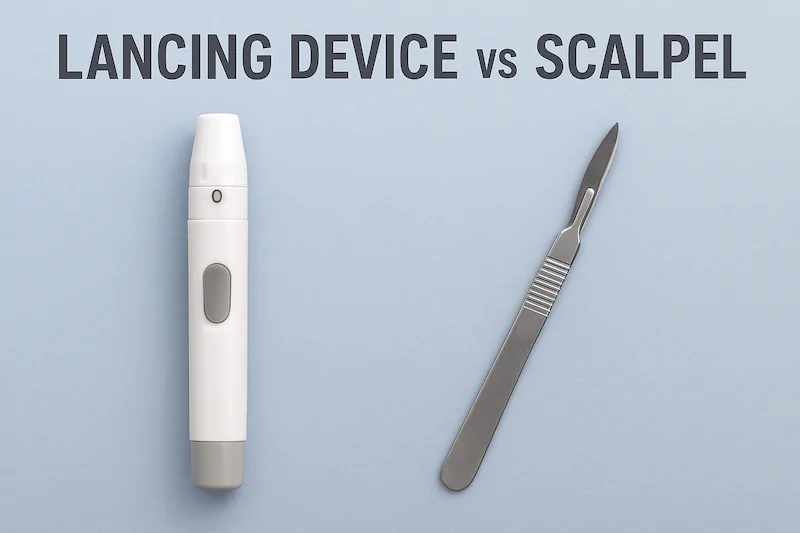
At first glance, both tools seem capable of creating the small micro-openings needed for a safe wet cupping session. However, their risk level, precision, and practicality are very different. Most experienced practitioners agree that beginners should take the safest possible route. In fact, many wet cupping practitioners with 10–20 years of experience still avoid using a scalpel entirely, not because they cannot use it—but because there is rarely a situation that justifies the extra risk.
Below is a clear, practical, and well-researched comparison to help you understand which tool supports safety, consistency, and gentle technique—especially for those just starting out.
Why Beginners Need to Prioritize Safety Above All
Wet cupping itself is already a technical practice that requires calm hands, body awareness, and sterile preparation. Introducing unnecessary sharp instruments increases the risk of:
- deeper cuts
- difficulty controlling incision depth
- uneven openings
- excessive bleeding
- contamination risk
- longer healing time
This is why tool choice matters so much. The goal is not to make wide or dramatic incisions—it’s simply to create tiny, consistent micro-openings that allow stagnant fluids to be released without harming the surrounding tissue.
Most beginners do not realize that the best wet cupping sessions operate on precision, not force. This is where the difference between lancing devices and scalpels becomes extremely important.
Why a Lancing Device Is Considered the Safest Option
Wet cupping itself is already a technical practice that requires calm hands, body awareness, and sterile preparation. Introducing unnecessary sharp instruments increases the risk of:
- deeper cuts
- difficulty controlling incision depth
- uneven openings
- excessive bleeding
- contamination risk
- longer healing time
This is why tool choice matters so much. The goal is not to make wide or dramatic incisions—it’s simply to create tiny, consistent micro-openings that allow stagnant fluids to be released without harming the surrounding tissue.
Most beginners do not realize that the best wet cupping sessions operate on precision, not force. This is where the difference between lancing devices and scalpels becomes extremely important.
Why a Lancing Device Is Considered the Safest Option
A lancing device is originally designed for controlled micro-punctures—usually for diabetic blood tests. This makes it inherently suitable for wet cupping beginners.
- Controlled Depth
A lancing device is built with a mechanical stop, meaning the needle only penetrates a very shallow and fixed depth. This control protects beginners from unintentionally making cuts that are too deep, too long, or angled.
- Consistent Openings
Each click produces uniform micro-openings. For beginners, consistency is far more important than “strength.”
- Lower Bleeding Risk
Because the punctures are tiny and shallow, the technique produces enough blood flow for wet cupping without triggering excessive bleeding.
- Extremely Low Learning Curve
Most people can learn to use a lancing device in minutes. There’s no angle adjustment, no blade control, and minimal hand pressure required.
- Widely Trusted in Modern Wet Cupping
A large portion of global practitioners—especially in clinics following stricter safety standards—use lancing devices for nearly all body areas except a few special cases.
And here’s an important reality that many beginners don’t know: Even practitioners with 20 years of experience often stick with a lancing device. Why? Because:
- it reduces risk
- it keeps procedures predictable
- it minimizes tissue trauma
- it allows cleaner aftercare
- clients feel more comfortable
For most wet cupping protocols—especially migraine, insomnia, upper-back tension, mastoid points, cervical release, and stress-related sessions—a lancing device is more than enough.
Why a Scalpel Is Generally Not Recommended for Beginners
A scalpel is a surgical blade designed for incisions, not micro-punctures. Even when used lightly, the blade can cut deeper or wider than intended.
- High Risk of Accidental Deep Cuts
Beginners often misjudge pressure or angle. Even a 1–2 mm mistake can cause unnecessary pain or prolonged healing.
- Difficult to Control
A scalpel blade demands:
- angle precision
- steady wrist control
- correct pressure distribution
- constant monitoring
This takes significant training and is not ideal for home practice or early stage learners.
- Not Suitable for Sensitive Areas
Certain areas should never be touched with a scalpel, even by experienced practitioners:
- face
- around the eyes
- mastoid region (behind ears)
- cervical points
- thin-skinned individuals
These areas require gentle micro-openings—not slicing motions.
- Higher Bleeding Risk
A scalpel incision typically creates:
- more bleeding volume
- less controlled flow
- wider exposure to contaminants
- slightly longer healing time
This increases the burden of aftercare.
- The Professional Consensus
Even highly experienced practitioners rarely use a scalpel unless absolutely necessary (such as hardened skin or scar tissue).
In real-world practice, over 90% of routine wet cupping sessions can be performed perfectly with a lancing device alone.
How Wet Cupping Benefits From Consistent Micro-Openings
Regardless of the tool, the purpose of the micro-openings is to:
- allow stagnation to exit
- reduce superficial congestion
- improve circulation in targeted areas
- support the body’s natural recovery signals
A lancing device achieves all these outcomes while minimizing tissue trauma. Scalpel incisions do not increase benefits—only risks.
Practical Guidelines to Reduce Risk and Improve Results
If you’re a beginner, follow these foundational habits:
- Use a fresh sterile lancet each time
Never reuse. This keeps infection risk extremely low.
- Clean the skin thoroughly
Use alcohol swabs or antiseptic solution.
- Keep the openings small
More openings are safer than deep openings.
- Avoid high-risk regions
Especially thin skin, the face, front neck, or areas with visible veins.
- Start with “safe zones”
Such as:
- upper back
- trapezius
- shoulder belt
- thoracic region
6. Learn proper cup timing
Pressures of 3–5 minutes are usually enough before lancing.
- Monitor the healing
Small dots should close within hours.
Conclusion: The Safest Answer for Beginners Is Clear
When comparing both tools side by side, the conclusion is direct:
 Lancing Device = Safe, Practical, Controlled, Beginner-Friendly
 Scalpel = High-risk, Hard to Control, Requires Experience, Not for Beginners
Wet cupping should feel empowering, not stressful. Choosing the safer tool allows you to focus on technique, hygiene, consistency, and good outcomes—with minimal chance of causing avoidable injuries.
If you want a clear, beginner-friendly guide that walks you through safe techniques, point selection, and real protocols for migraine or insomnia, you can explore the Wet Cupping for Beginners free e-book. It’s written to help you build confidence step by step—without overwhelm, without guesswork, with video tutorial.