
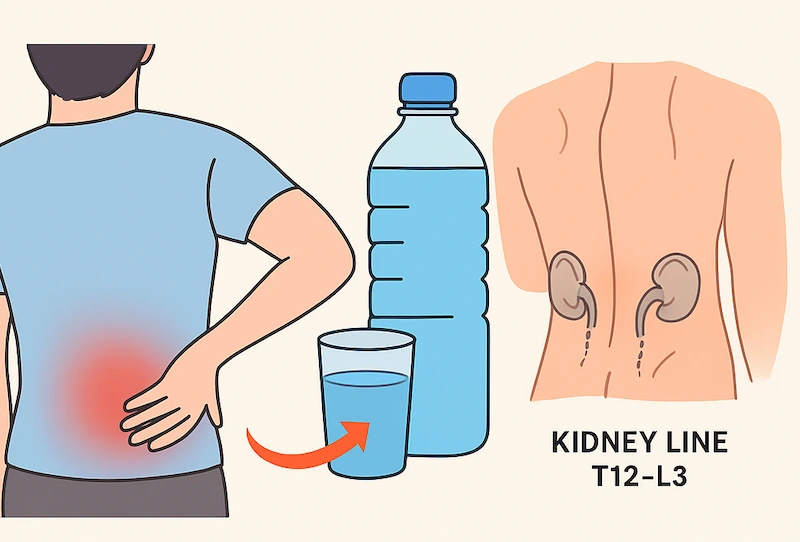
Persistent lower-back tightness can be frustrating—especially when painkillers don’t work and stretching provides only temporary relief. Many people overlook a surprisingly effective tool: rapid hydration, often called “water loading,” combined with wet cupping on the paraspinal points near the kidney line (roughly T12–L3 vertebrae).
This approach is physiological, not magical. It works through improved circulation, fascia hydration, and targeted local release.
Why Lower Back Tightness Often Responds to Hydration
Low-back discomfort that seems sudden usually develops gradually due to:
- Mild dehydration
- Increased blood viscosity
- Reduced fascial glide around the lumbar region
- Muscle guarding triggered by poor fluid balance
Extra stress on the kidneys
Blood Volume and Tissue Perfusion Improve Quickly
Drinking about 1.5 liters of water in a short window (5–10 minutes) can:
- Expand plasma volume
- Reduce blood viscosity
- Improve microcirculation
- Relax tissues stiff from poor perfusion
In practice, a 58-year-old patient with resistant back pain noticed symptom relief within a day, and by day three, mobility was restored. While anecdotal, this aligns with basic circulatory physiology.
Fascia Needs Water to Glide
The thoracolumbar fascia—the thick connective tissue in the lower back—relies heavily on hydration. Dehydration makes fascia:
- Sticky
- Less elastic
- More sensitive to stretch
Rapid rehydration often restores glide, creating a sensation of the back “unlocking” within hours.
Kidney Stress and Muscular Guarding
Low hydration increases the osmotic load the kidneys must manage. When kidneys work harder:
- Muscles around the lumbar region, especially the quadratus lumborum, may tighten reflexively
- Surrounding fascia becomes more rigid
- Dull aching along the waistline may appear
Hydration alone can sometimes dramatically reduce discomfort along the kidney zone.
Rapid Hydration Protocol (about 1.5 L in 5–10 Minutes)
Used occasionally during:
- Lumbar heaviness
- Waist tightness
- Mild dehydration
- Mental fatigue
- Early signs of muscle spasm
Steps:
- Drink about 1.5 liters of clean water in 5–10 minutes
- Do it on an empty stomach, 1 hour before meals
- Expect increased urination (normal)
- Repeat 1–3 days during an episode
Most people report feeling lighter, warmer, clearer, and more mobile in the lower back.
Why Wet Cupping Near the Kidney Line Enhances the Effect
Hydration Expands Plasma; Wet Cupping Redistributes Local Fluids
Combining rapid hydration with wet cupping over the paraspinal lumbar zone (T12–L3) amplifies results. Cups are placed about 2–3 finger-widths lateral to the spine, bilaterally, following the natural curve of the paraspinal muscles.
Rapid hydration improves systemic fluid dynamics. Wet cupping then:
- Draws blood to the surface
- Unloads congested capillary beds
- Encourages metabolic waste movement
Combined, these actions improve local perfusion, reduce stagnation, and soften the lumbar region.
Kidney-Line Points Are Naturally Fluid-Sensitive
Points along T12–L3 lie over major fascial junctions and connect to muscles prone to guarding during dehydration. Stimulating these points after hydration produces a stronger, noticeable release than cupping alone.
Fascial Hydration Improves the Cupping Response
Well-hydrated fascia:
- Separates more easily
- Responds better to negative pressure
- Feels less tender during treatment
Hydration before cupping allows cups to lift tissue smoothly and comfortably.
Who Benefits Most
People likely to notice rapid improvement include those who:
- Forget to drink regularly
- Consume lots of coffee or tea
- Sit long hours or work in air-conditioned environments
- Have chronic lumbar tightness
- Are older (reduced natural thirst signals)
This profile matches the patient example: 58 years old, long-standing pain, poor response to medication, rapid improvement after hydration.
Safety Considerations
- Rapid hydration is generally safe for healthy adults.
- Avoid or consult a doctor if you have heart failure, kidney disease, uncontrolled hypertension, or fluid restrictions.
- Wet cupping should always be performed by trained practitioners.
Why This Simple Method Works
The combination of structured rapid hydration + wet cupping along the kidney line addresses low-back tightness on three levels:
- Systemic – Increases blood volume, reduces viscosity, improves circulation
- Local – Wet cupping clears congestion in areas stiffened by dehydration
- Fascial – Hydration restores glide; cupping decompresses congested planes
The synergy explains why some people experience fast relief—not magic, just physiology in action.
Dehydrated and your lower back hurts? See how rapid hydration + wet cupping can help → Read the wet cupping at home.