
If your hands feel weaker than they used to—struggling to open jars, hold objects firmly, or maintain grip during daily tasks—you’re not alone. Grip weakness is a highly common but often misunderstood symptom. Most people assume it’s just “fatigue,” “getting older,” or “overusing the hands.” But in many cases, the real issue is hidden inside the forearm tunnels, where nerves and blood vessels travel to your wrist and fingers.
When these tunnels become tight, congested, or inflamed, the brain’s signals to the hand no longer travel efficiently. This creates a subtle decline in strength, fine motor control, and endurance.
The good news?
With the right understanding—and targeted wet cupping—there’s a natural way to restore circulation, decompress the tunnels, and bring hand strength back online.
The Hidden Mechanics of Grip Strength
Grip strength depends on three major systems working together:
1. Forearm Flexor Muscles
These muscles power your ability to squeeze, pinch, and hold objects. They run from the inner elbow all the way down to the wrist.
2. Tendons That Travel Through Tight Tunnels
The flexor tendons pass through narrow spaces such as the:
- carpal tunnel
- Guyon’s canal
- flexor compartments
- forearm fascial lines
Any swelling or inflammation here immediately weakens your grip.
3. Nerves That Fire the Muscles
The median nerve, ulnar nerve, and radial nerve act like electrical cables. If they are compressed, grip strength drops even if the muscles are still healthy.
This is why someone can feel:
- weak grip
- numbness
- tingling
- fingers “not listening”
- slow reaction time
- poor hand stamina
…all without any noticeable pain.
What Actually Causes Weak Grip? (The Real Culprits Most People Miss)
1. Micro-Compression in the Forearm
Modern life forces your wrist into repetitive positions:
- typing
- holding the phone
- gripping the steering wheel
- lifting objects with poor wrist alignment
This causes micro-swelling in the fascia that surrounds your nerves. Over time, the nerve’s conductivity decreases → grip becomes weaker.
2. Wrist Flexor Congestion
Every time you grip something, the flexor muscles contract. But when they never get decompressed, blood flow becomes sluggish, leading to:
- tightness
- stiffness
- cold hands
- weak fingers
3. Carpal Tunnel Pressure
Even mild pressure is enough to drop strength by up to 30%.
4. Ulnar Nerve Fatigue
This nerve controls:
- ring finger strength
- pinky alignment
- side grip stability
If it gets irritated near the elbow or wrist, grip becomes noticeably unstable.
5. Dehydration Thickens Tissues
Dehydrated fascia becomes sticky. Sticky fascia traps nerves. Trapped nerves = weak grip + poor endurance. Simple hydration often improves strength within hours—but only if circulation is restored.
Why Wet Cupping Helps Restore Grip Strength
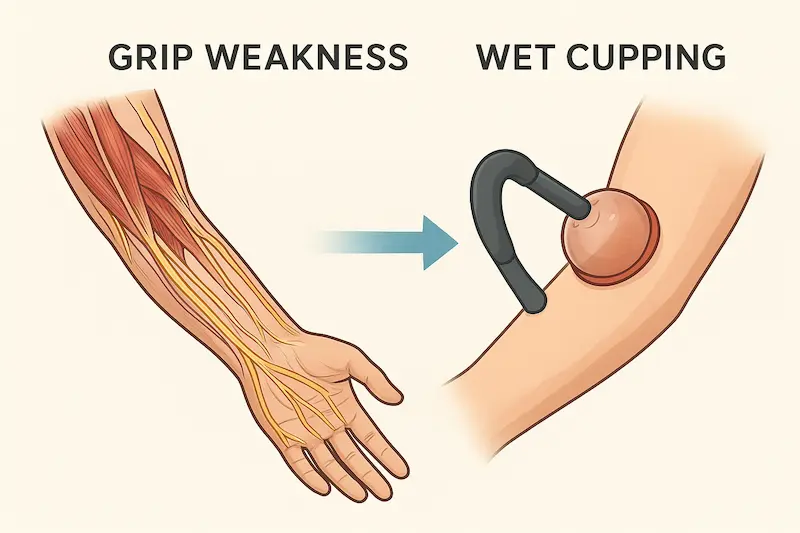
Wet cupping is uniquely effective for grip weakness because it targets the problem at its root: compression → stagnation → reduced nerve flow.
Here’s what happens physiologically:
1. It Decompresses the Forearm Tunnels
By lifting the skin and fascia upward, wet cupping:
- creates space
- reduces mechanical pressure
- frees the nerves
- softens the tendon pathways
This is something stretching alone cannot achieve.
2. It Improves Microcirculation
A congested forearm = slow blood flow = weaker muscle activation. Wet cupping pulls out stagnant fluid and boosts fresh circulation.
3. It Resets Nerve Signaling
When pressure decreases around the median and ulnar nerves, their conduction improves.
As a result:
- grip strength increases
- fingers respond faster
- hand endurance improves
tingling decreases
4. It Removes Local Inflammatory Byproducts
Forearm overuse accumulates inflammatory metabolites. Wet cupping clears these residues and reduces local irritation.
5. It Restores Flexor–Extensor Balance
Many people have dominant flexors and weak extensors. This imbalance collapses the wrist and weakens the entire grip chain. Wet cupping helps reset tissue tension so both groups can function properly.
The Best Wet Cupping Points for Grip Weakness
Main Forearm Line (Voluntary Grip Power)
- Flexor digitorum area
- Pronator teres zone
- Median nerve pathway
Ulnar Nerve Line (Finger Stability & Side Grip)
- Medial forearm
- Near Guyon’s canal and ulnar tunnel (safe areas only)
Dorsal Wrist Line (Finger Extension & Coordination)
- Extensor digitorum compartments
- Tendon retinaculum
Supplemental Point
- Between thumb and index metacarpals (for pinching strength)
These points decompress the nerve + tendon pathways that determine how strong and stable your grip feels.
Recovery Tips to Boost Results
- Hydrate 1–1.5 liters in short intervals. Helps thin the fascia and improve nerve glide.
- Gentle wrist extension & tendon gliding. Prevents re-congestion of tunnels.
- Posture reset. Forward shoulders increase nerve traction all the way down to the wrist.
- Avoid tight gripping for 24 hours. Let the decompressed tissue settle.
Conclusion
Grip weakness isn’t random and it’s rarely “just aging.” Most cases come from hidden compression in the forearm tunnels that interferes with nerve flow and blocks proper muscle activation. Wet cupping directly addresses these root causes by decompressing, clearing inflammation, and restoring smooth circulation along the nerve pathways.
As nerve conductivity improves, strength returns, finger coordination becomes sharper, and the hand finally feels alive again.
A weakening grip isn’t random — it’s often caused by hidden forearm tension and subtle nerve compression that most people never notice. Wet cupping helps decompress these pathways and restore the natural strength in your fingers and hand. Rebuild your grip strength, lighten your forearm, and support healthier nerve function the natural way in our upcoming e-book.
Get free Natural Reset: Modern wet cupping made simple e-Book and discover how to perform wet cupping safely at home.