
During Ramadan, many people who practice wet cupping ask a practical and important question: Is it better to do wet cupping before Iftar or after breaking the fast?
Fasting alters hydration patterns, circulation dynamics, and digestive activity. Because wet cupping interacts with blood flow, microcirculation, and autonomic regulation, timing matters. The goal is not to avoid wet cupping during Ramadan, but to align it with the body’s fasting physiology.
An evidence-based answer avoids extremes. Wet cupping is neither inherently risky during fasting nor something that should be performed carelessly without regard to bodily readiness.
How Fasting Changes the Body
During daily fasting hours, the body undergoes predictable and reversible adaptations:
- Insulin levels decrease
- Fat metabolism increases
- Circulating plasma volume becomes slightly more concentrated
- Digestive activity pauses, reducing blood flow to the gut
These changes are well tolerated in healthy individuals, especially when hydration and nutrition are restored during non-fasting hours. Importantly, wet cupping primarily affects local circulation and regulatory mechanisms, not systemic energy stores.
The Importance of an Empty Stomach
Regardless of timing, one core principle of wet cupping remains consistent: it is best performed on a relatively empty stomach.
During Iftar, the body rapidly shifts from fasting to digestion. Heavy or excessive eating causes increased blood flow to the gastrointestinal system and temporary circulatory redistribution. Performing wet cupping too soon after a large meal may reduce comfort and tolerance.
For this reason, experienced practitioners commonly recommend:
- Keeping Iftar meals moderate
- Avoiding overeating or excessive fluid loading
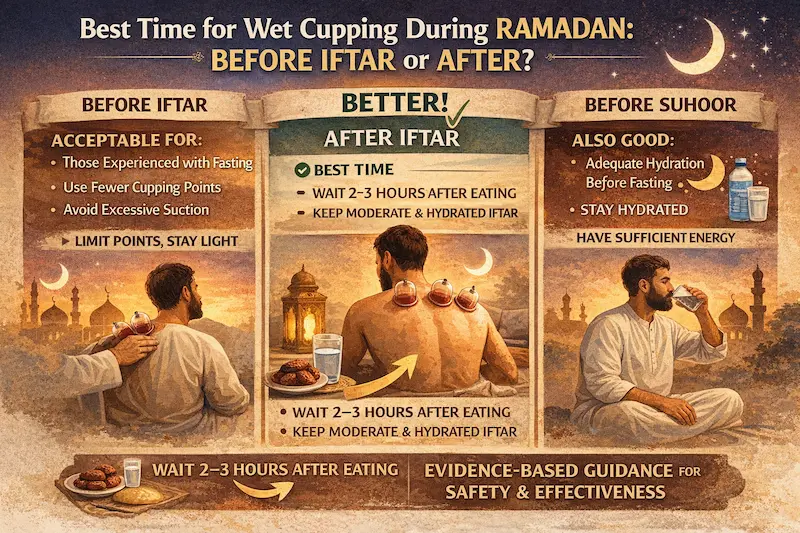
- Waiting approximately 3 hours after eating before wet cupping
This allows digestion to stabilize while maintaining adequate hydration, creating a more physiologically favorable window for the procedure.
Wet Cupping Before Iftar
Performing wet cupping before Iftar means undergoing the procedure during the fasting window.
When It May Be Suitable
- For individuals accustomed to fasting
- For those who do not experience weakness easily
- When sessions are light and focused
From a religious and historical perspective, authentic reports indicate that the Prophet Muhammad underwent wet cupping while fasting. Most scholars hold that wet cupping does not invalidate the fast, though delaying it is advised if it causes weakness.
Practical Adjustments During Fasting
When wet cupping is done before Iftar:
- Fewer cupping points are used
- Excessive suction is avoided
- Sessions are shorter and more targeted
This approach respects the fasting state while still allowing wet cupping to act on local blood stagnation and regulatory pathways.
Wet Cupping After Iftar
For most people, the best time, after Iftar is the most comfortable and safest option.
Once hydration and initial nourishment are restored:
- Plasma volume improves
- Blood pressure stabilizes
- Tolerance to mild blood release increases
However, timing still matters. Wet cupping should not be performed immediately after eating. Allowing a 3 hour gap ensures digestion has settled and circulation is balanced.
From a modern physiological perspective, this timing offers the highest margin of comfort and consistency.
What About Before Suhoor?
Another favorable window is before Suhoor.
Advantages include:
- Adequate hydration afterward
- Stable energy levels for many individuals
- Sufficient recovery time before daytime fasting begins
For some, this timing combines the benefits of fasting compatibility and digestive readiness.
Root Mechanisms and Symptom Relief
Wet cupping during Ramadan is sometimes framed as merely easing fatigue or discomfort. This overlooks its biological action.
Wet cupping acts on identifiable mechanisms, including:
- Local blood stagnation
- Microcirculatory congestion
- Low-grade inflammatory signaling
- Neurovascular regulation
Symptom relief—such as reduced heaviness, tension, or fatigue—is a secondary outcome of these processes, not the sole objective. This dual action aligns with how many accepted medical interventions function.
Practical Timing Summary
Best overall timing for most people:
- After Iftar, with a 2–3 hour gap after eating
Also suitable:
- Before Suhoor, with proper hydration
Conditionally acceptable:
- Before Iftar, using fewer points and lighter technique
The optimal choice depends on hydration status, individual tolerance, and practitioner judgment—not rigid rules.
Final Verdict
There is no inherent conflict between Ramadan fasting and wet cupping when practiced thoughtfully.
By respecting the empty-stomach principle, moderating Iftar intake, adjusting technique during fasting hours, and prioritizing hydration, wet cupping can be integrated safely and coherently into the Ramadan routine.
Want to learn how to schedule wet cupping during Ramadan, choose the right points, and support recovery with proper hydration? Explore our complete Ramadan wet cupping guide for clear, evidence-based practice.