
If you’ve ever noticed round red marks on the backs of athletes or spa-goers, you’ve already witnessed the result of cupping therapy — an ancient healing art that uses suction to stimulate blood flow, relieve muscle tension, and support the body’s natural detox process.
Over thousands of years, this practice evolved into several distinct forms, the most well-known being dry cupping, which relies purely on suction, and wet cupping, which includes a mild blood release to draw out stagnant fluids and restore balance. While both share the same roots, wet cupping holds a deeper place in traditional medicine — bridging detox, circulation, and rejuvenation in one integrated ritual.
From the tombs of Egyptian physicians to modern sports clinics, the evolution of cupping therapy tells a powerful story: how ancient wisdom continues to shape modern wellness.
Ancient Roots in Egypt, China, and Persia
The earliest records of cupping come from ancient Egypt, around 1550 BCE. The Ebers Papyrus, one of the oldest medical manuscripts ever found, describes using heated glass or hollow animal horns to “draw out bad blood.” Egyptians believed that stagnation — trapped, unmoving blood — was the hidden cause of pain and disease.
From Egypt, the practice spread eastward to China, where it intertwined with acupuncture and meridian theory. Ancient Chinese physicians used bamboo cups and fire suction to move qi (life energy) through blocked channels. The Bo Shu, a medical text from the Han Dynasty, documents cupping for conditions like lung congestion, back pain, and inflammation.
Meanwhile in Persia, legendary scholar Avicenna (Ibn Sina, 980–1037 CE) refined the practice in his Canon of Medicine. He was one of the first to distinguish between dry cupping (for energy flow) and wet cupping (for detoxifying the blood). Wet cupping — known as Hijama in Arabic — became central to Islamic medicine, recommended for ailments like hypertension, fatigue, and chronic pain.
By the medieval era, cupping had become a truly global healing tradition — practiced from North Africa to Asia, and adapted to local medical philosophies wherever it went.
Transition to Modern Wellness Clinics
Cupping remained a household remedy for centuries, used by both physicians and midwives. But by the early 20th century, it began to fade in the West as biomedicine and pharmaceuticals took center stage. Hospitals replaced physical therapies with chemical solutions, and cupping survived mainly in Asia and traditional Arab practices.
Then came the wellness revolution of the 1990s. As people sought natural and holistic treatments, massage therapists, acupuncturists, and integrative clinics rediscovered cupping — not as “old medicine,” but as a gentle, noninvasive detox method.
When Michael Phelps appeared at the 2016 Olympics with visible circular marks on his shoulders, the world took notice. Almost overnight, modern cupping became a wellness symbol associated with recovery, balance, and athletic performance.
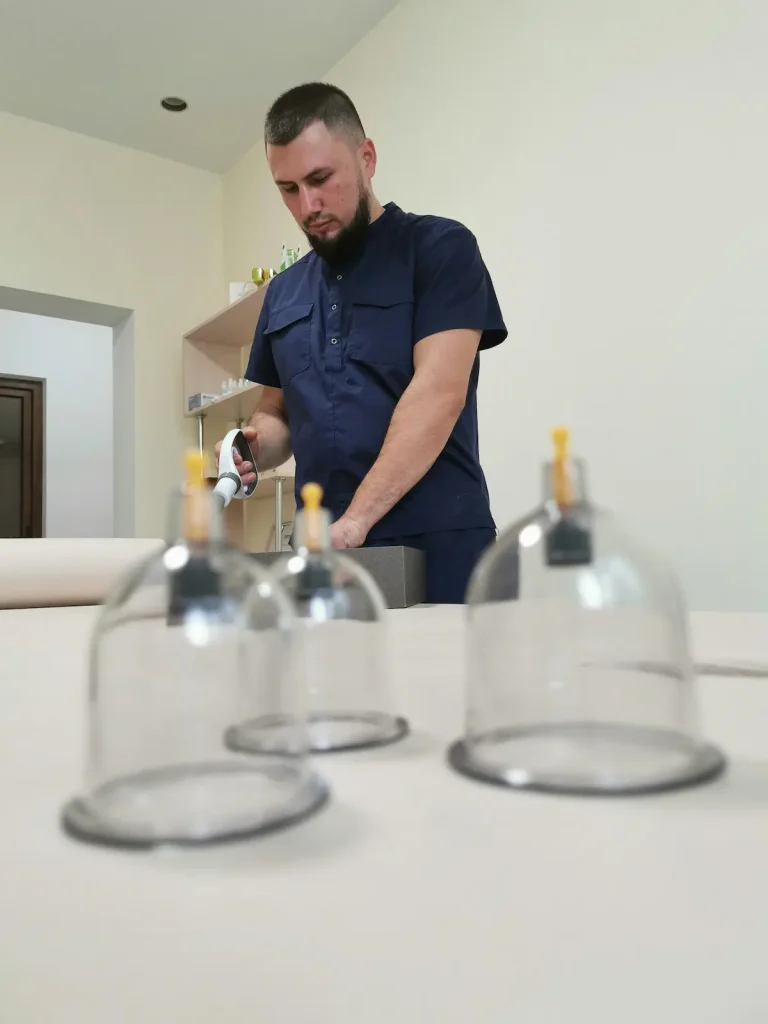
Today, cupping is found everywhere from luxury spas to sports physiotherapy centers. The tools may have changed — silicone and vacuum cups have replaced fire-heated glass — but the goal remains timeless: to stimulate circulation, relieve stress, and restore balance.
How Cupping Works Beneath the Skin
Modern science explains cupping’s visible marks through a simple mechanism: negative pressure draws blood toward the skin’s surface, stretching capillaries and triggering microcirculation. This temporary suction effect increases oxygen flow and helps flush out metabolic waste.
In wet cupping, small incisions allow for the removal of stagnant, deoxygenated blood, creating a mild detox effect that many practitioners associate with improved energy and reduced inflammation. The process is gentle but physiologically active — a reset for your body’s internal flow system.
Why Wet Cupping Survived the Centuries
Among all variations, wet cupping has endured the longest. Its staying power lies in one biological truth: the human body needs to move, cleanse, and renew its fluids.
Unlike dry cupping, which works through suction alone, wet cupping involves a mild blood release. This process removes old, deoxygenated blood, allowing new, oxygen-rich blood to flow in. Traditional practitioners call this “removing stagnant blood,” while modern researchers describe it as enhancing microcirculation and detox pathways — different languages, same insight.
Scientific studies, including Ernst & Lee (2011) and Al-Bedah et al. (2016), show that cupping may reduce inflammation, promote immune balance, and improve tissue oxygenation. The results echo centuries of empirical observation.
In Muslim-majority countries, Hijama continues to be practiced both for its spiritual meaning and its physiological benefits, often performed on specific lunar days believed to enhance cleansing. Its endurance across civilizations reflects a rare harmony between faith, biology, and lived experience.
Cupping in Modern Sports and Integrative Medicine
The past decade has seen cupping re-enter the realm of evidence-based medicine. No longer confined to cultural traditions, it now complements physiotherapy, acupuncture, and manual therapy in clinics worldwide.
Sports scientists use it to reduce oxidative stress, promote recovery, and enhance circulation after intense exercise. In integrative medicine, wet cupping has been explored for chronic pain, migraine, and even metabolic disorders.
A study by Tagil et al. (2014) confirmed that wet cupping improves oxygen delivery and local tissue perfusion, validating what healers already knew: better flow equals faster healing. Hospitals in China and Germany have also begun incorporating cupping into rehabilitation programs, particularly for musculoskeletal conditions.
Even the World Health Organization has recognized cupping as part of humanity’s traditional medicine heritage, alongside acupuncture and herbal medicine.
From Horns to Glass to Science
The evolution of cupping therapy mirrors humanity’s timeless search for balance between nature and science. What began with animal horns and fire has become a subject of modern biomedical research and a global symbol of holistic self-care.
Whether practiced in a wellness spa or clinical setting, wet cupping continues to bridge ancient wisdom and modern science, reminding us that true healing doesn’t always come from new inventions — but from rediscovering what already works.
Key Takeaway:
The journey of cupping — from Egyptian papyri to Olympic athletes — shows that real wisdom doesn’t expire; it evolves. The evolution of cupping therapy proves that even in a world of rapid innovation, ancient methods rooted in balance, flow, and renewal still hold powerful relevance today.