
If you’ve started noticing a rounded upper back, a forward-jutting head, or that “hunched” look in photos, you’re not alone. Modern lifestyle habits—long hours at a screen, shallow breathing, stress, weak postural muscles—push the upper back into a rounded curve that becomes harder to reverse the longer it stays.
The good news? Hunchback posture isn’t permanent. With the right combination of mobility work, targeted strengthening, rib expansion, and restoring proper upper-back circulation, you can gradually reshape the area and reduce the heaviness, stiffness, and fatigue that usually accompany it.
Below is a simple, science-aligned breakdown of why hunchback posture happens and how to start correcting it safely from home.
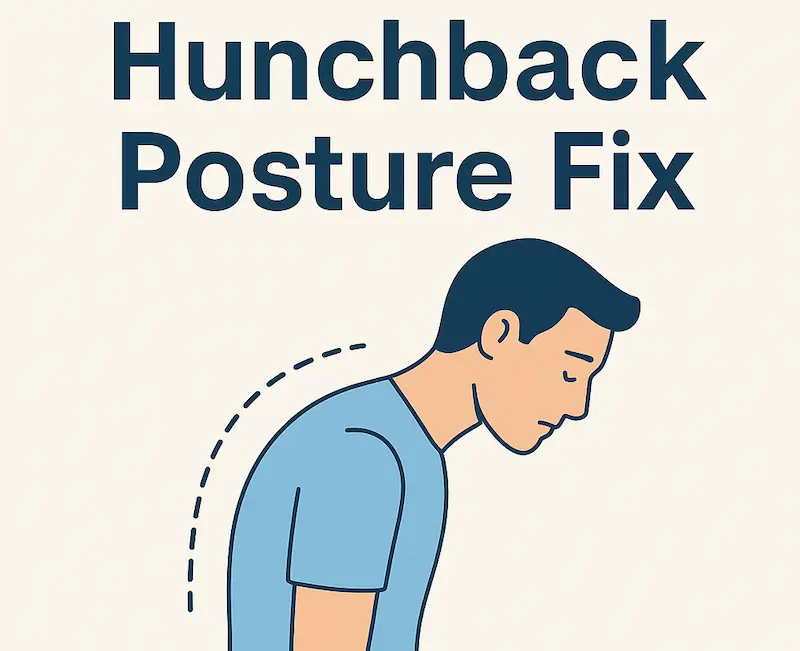
Why You Develop a Hunched Posture
Forward-Head Habits
When the head is positioned even a few centimeters in front of the shoulders, your upper-back muscles must work overtime to hold it up. Over weeks and months, these muscles stiffen, weaken, and eventually adapt into a rounded shape.
Tight Chest + Weak Mid-Back Muscles
People with hunched posture almost always have:
- Tight chest muscles (pulling the shoulders forward)
- Weak upper-back stabilizers (unable to counterbalance that pull)
This imbalance compresses the front of the rib cage and overstretches the tissues behind it, creating the classic rounding.
Reduced Rib Mobility
The rib cage expands when you breathe deeply.
But shallow, stress-driven breathing makes the ribs move less than they should.
Over time:
- The spaces between ribs stiffen
- Upper-back tissues lose glide
- Circulation slows
- The whole area becomes rigid
This rigidity pushes the back into a “stuck” rounded shape.
Screen and Sitting Posture
Most people don’t slump because their posture is “bad”—they slump because gravity slowly wins when the body is inactive for long periods.
Long sitting compresses:
- The upper back
- The shoulder-blade region
- The tissues that help you hold your chest open
Eventually the posture becomes the new default.
Stress and Breath Locking
When stressed, people unknowingly lift their shoulders, tighten the neck, and restrict their upper-back breathing.
This creates:
- Micro-tension behind the shoulder blades
- Reduced oxygenation
- A “heavy” upper-back sensation
If repeated daily, the curve deepens.
How to Fix Hunchback Posture (At Home, Gradually)
Open the Chest
Undo the tension that pulls your shoulders forward.
Two simple releases:
- Doorway chest stretch (20–30 seconds)
- Foam roller thoracic extension (slow, controlled)
These stretches help restore rib opening and ease front-body compression.
Strengthen the Mid-Back
Without strength, posture will collapse again even after stretching.
Focus on:
- Scapular retractions
- Prone Y-T-W movements
- Rowing motions (resistance band works great)
These exercises reactivate the muscles that hold your shoulder blades down and back—your natural “anti-hunch” system.
Restore Rib Mobility Through Deep Breathing
This is one of the most overlooked elements.
Try slow, deep rib expansion:
- Hand on the sides of the ribs
- Inhale by expanding the ribs outward and backward
- Exhale slowly
This helps:
- Reopen stiff tissue between ribs
- Improve upper-back circulation
- Reduce the tight, heavy feeling behind the shoulders
Micro-Movement Breaks (Every 45–60 Minutes)
Posture isn’t fixed by one big session—it’s fixed by hundreds of tiny resets.
Do this simple reset:
- Stand tall
- Roll shoulders back
- Lift your chest slightly
- Take three slow deep breaths
Repeat throughout the day.
Wet Cupping for the Upper Back (Optional Boost)
Many people with hunchback posture experience:
- Tightness behind the shoulder blades
- Heaviness in the upper back
- Poor circulation around the area that should help hold posture upright
Wet cupping along the upper-back region can help:
- Reduce trapped tension
- Improve blood flow
- Restore mobility
- Relieve heaviness that worsens rounding
While not a substitute for strengthening, it enhances tissue flexibility so exercises work faster.
Strengthen the Core and Lower Rib Support
Your spine can’t maintain alignment if your core is too weak to support the rib cage. Simple core work like planks or dead bug variations helps maintain the chest-up, rib-lifted posture you need for a straighter back.
If your upper back feels heavy, stiff, or rounded, learn the simple home routine that combines posture training, rib mobility, and strategic wet cupping to help restore your natural alignment. Read the free full guide in our e-book: Wet Cupping Made Simple