
Finger tingling—whether it feels like buzzing, pins and needles, light numbness, or a mild electrical sensation—can interfere with typing, gripping, scrolling, and everyday hand movement. Most people assume finger tingling always comes from the neck or carpal tunnel, but in many real-world cases, the source sits much closer: the forearm, wrist, and dorsal hand tissues that surround the small sensory nerves.
These tissues can tighten, thicken, or lose glide over time, especially in people who type for long hours, grip objects repetitively, or work with tools. When this happens, the delicate nerve branches that travel toward the fingers become irritated, causing the familiar tingling sensations. Wet cupping offers a decompression-based solution that helps restore nerve flow, improve microcirculation, and release areas of hidden pressure more effectively than stretching or massage alone.
This article explains the physiological chain behind finger tingling and how wet cupping helps reduce the symptoms naturally.
Why Finger Tingling Happens: The Real Physiological Chain
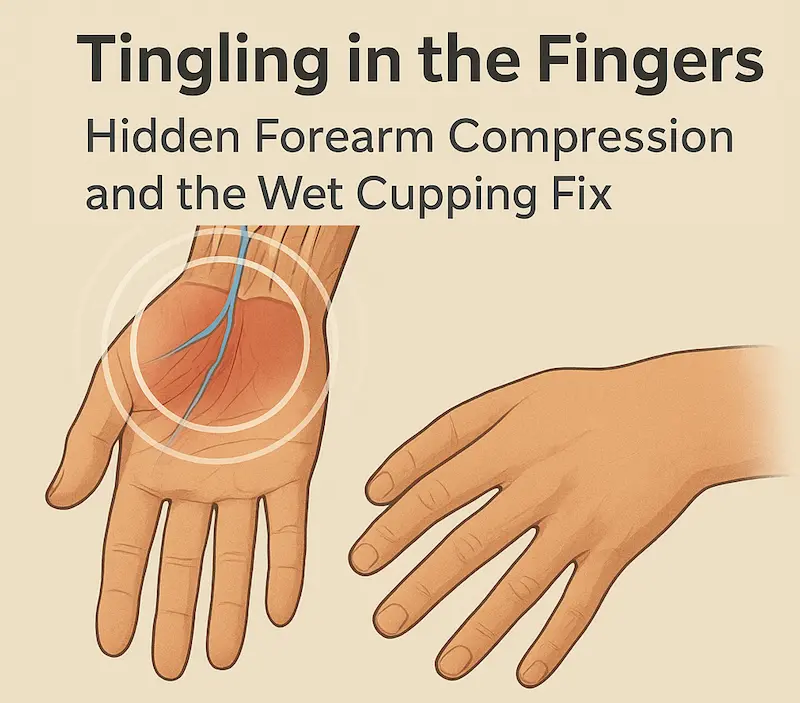
Finger sensation is supplied by branches of the median, radial, and ulnar nerves. Before reaching the fingers, these nerves travel through narrow corridors in the forearm and wrist—zones that easily tighten due to repetitive strain, posture, or micro-congestion. Here are the most common contributors that create tingling in everyday cases.
1. Hidden Tightness in the Upper Forearm (Brachioradialis Region)
One of the most overlooked drivers of finger tingling is tension in the brachioradialis area—located on the thumb-side of the upper forearm. The superficial radial nerve passes through this region, and even a slight increase in tissue density can irritate its pathway.
Common symptoms include:
- Tingling on the back of the hand
- Electric sensations toward the thumb or index finger
- Forearm heaviness after typing
- Discomfort when extending the wrist
Because this region acts as an upstream “gateway,” releasing it often reduces downstream symptoms quickly.
2. Mid-Forearm Congestion Along the Extensor Line
The mid-forearm houses the extensor digitorum and extensor carpi ulnaris, two muscles essential for finger lifting and wrist stabilization. When these muscles tighten or lose glide, they create friction around the small nerve branches running alongside them.
This usually causes:
- Diffuse tingling down the forearm
- A tired, heavy wrist
- Stiffness that worsens after gripping
- Slower recovery after repetitive tasks
This region responds well to decompression because blood flow is often limited here despite continuous daily use.
3. Compression at the Wrist Band (Extensor Retinaculum)
The extensor retinaculum is a thick band that anchors the tendons at the back of the wrist. Because it is a rigid tunnel with little room for swelling, even mild tension or inflammation can irritate the nerves beneath it.
Typical symptoms include:
- Tingling during typing or phone use
- Numbness in the morning
- Reduced grip comfort
- A “tight strap” feeling across the wrist
This is one of the fastest-responding regions when wet cupping is applied correctly.
4. Micro-Restriction Across the Dorsal Hand
Between the bones of the back of the hand run the lumbrical and interosseous muscles—small structures responsible for finger coordination and stability. They often tighten from fine motor work such as typing, texting, drawing, or instrument playing.
Signs of restriction include:
- Tingling at the base of the fingers
- Subtle numbness
- A “dusting of electricity” feeling
- Discomfort spreading between the knuckles
Although small, these tissues heavily influence finger sensation and respond well to gentle decompression.
How Wet Cupping Helps Finger Tingling
Wet cupping does not treat nerve diseases directly, but it helps reduce the local mechanical issues that trigger nerve irritation. Its benefits come from a combination of negative pressure, improved microcirculation, and fascial decompression.
Here’s how it helps:
1. Decompressing Tight Nerve Pathways
Negative pressure lifts superficial tissue layers, decreasing the pressure on sensitive nerve branches. When the soft tissues unload, nerve signaling becomes smoother and less irritated.
2. Increasing Microcirculation in Congested Zones
The wrist and forearm are often poorly perfused, especially in people with sedentary or repetitive tasks. Wet cupping increases local blood flow, oxygenation, and nutrient delivery—supporting nerve health. Better circulation = fewer tingling sensations.
3. Releasing Deep, Hidden Muscle Tension
Typing and gripping create chronic tension that stretching rarely reaches. Wet cupping targets deeper layers, softening stiffness around the nerve pathways.
4. Reducing Friction at the Wrist Band
Since the extensor retinaculum cannot stretch, decompression is one of the most effective ways to reduce pressure beneath it. This leads to fast relief in many finger-tingling cases.
5. Improving Finger Mobility and “Lightness”
When the dorsal hand tissues relax and circulation improves, finger movement becomes smoother. Tingling decreases as the nerve endings regain better flow.
Key Recovery Habits
- Drink 1–1.5 liters of water after the session
- Avoid prolonged wrist extension or flexion
- Use gentle wrist circles and finger-spread exercises
- Reduce gripping-heavy tasks temporarily
Conclusion
Finger tingling is often not a nerve problem in the neck — but a compression issue hidden along the forearm, wrist band, and dorsal hand. When these tissues tighten, they narrow the spaces where superficial nerves travel, creating buzzing, pins-and-needles, or mild numbness. Wet cupping offers a natural decompression method that improves microcirculation, softens tight fascia, and restores smoother nerve signaling. With the right points—upper forearm, mid-extensor line, wrist retinaculum, and dorsal hand spaces—many people experience noticeable relief and better finger mobility.
Finger tingling often comes from subtle compression along the forearm and wrist. Wet cupping helps release these tight pathways, restore microcirculation, and calm the buzzing sensations in your fingers.
Explore the full technique in our upcoming next e-book and learn how to perform wet cupping safely at home in our free Natural Reset: Modern wet cupping made simple book.