
Waking up with hands that feel tight, stiff, or hard to move is far more common than most people expect. Many describe it as “morning hand stiffness,” “tight fingers,” or even “frozen hands,” where the fingers don’t immediately bend smoothly.
Most people assume the problem must come from arthritis, low circulation, or sleeping position. While those can contribute, a surprisingly large portion of morning hand tightness actually begins higher up — in the soft tissues of the forearm, where nerves and tendons travel before entering the hand.
This hidden congestion builds silently throughout the day and becomes most noticeable after sleeping, when circulation slows and the tissues tighten. Understanding this chain helps explain why wet cupping provides relief when stretching or wrist exercises alone fall short.
This article breaks down the real physiological reasons behind morning hand stiffness — and how forearm-focused wet cupping supports smoother mobility and lighter fingers upon waking.
Why Your Hands Feel Tight in the Morning: The Real Physiological Chain
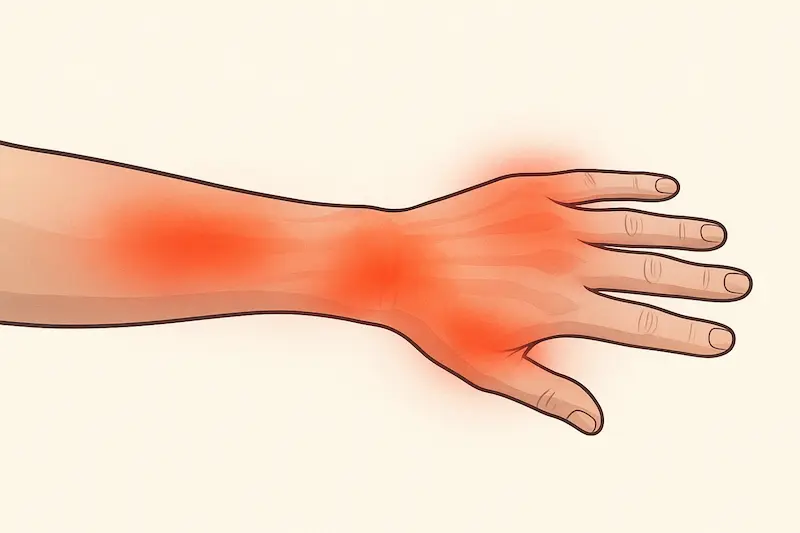
Your fingers don’t work alone. Every movement — gripping, flexing, spreading — begins in the forearm, where long tendons run through narrow tunnels toward the hand. When these tissues become congested, the hand becomes the first place you feel the effect.
Here are the three main contributors:
1. Overnight Fluid Stasis in the Forearm
During the day, your hands and forearms rely on constant micro-movement to push blood and lymph through the tissues. When you sleep, especially for 6–8 hours without motion:
- Circulation slows
- Fluid accumulates
- Tendons and fascia become “sticky”
- Nerve pathways lose glide
This creates a stiff, tight, or mildly numb sensation when you first wake up.
People who type frequently, lift objects, grip tools, or have mild inflammation in the forearm extensor or flexor regions often experience worse morning tightness.
Why this matters:
Tendon glide is reduced. When the tendons cannot slide smoothly inside their sheaths, the fingers feel slow, resistant, or “rusty.”
2. Hidden Congestion Around the Wrist Tunnel
Just before entering the hand, all flexor and extensor tendons pass under narrow structures such as:
- Flexor retinaculum (palm side)
- Extensor retinaculum (dorsal side)
These act like tight bands or tunnels. Overnight, low-grade swelling or tissue thickening reduces the available space even more.
Common symptoms include:
- Stiff fingers
- Difficulty making a fist
- “Cement-like” hands in the morning
- Slow or painful first grip
- Clicking or resistance at the first bend
This is not always carpal tunnel syndrome. Often, it is forearm-induced congestion that settles into the wrist during sleep.
3. Micro-Tightness in the Intrinsic Hand Muscles
Even though the problem usually starts in the forearm, the small muscles inside the hand also contribute. These muscles tighten when:
- You sleep with your hands curled
- You grip a pillow
- Your wrists remain flexed or extended
- You type or scroll frequently during the day
When the intrinsic hand muscles stiffen, the fingers lose their early-morning mobility. You might notice:
- Difficulty straightening the fingers
- Slow grip response
- Mild tingling at the fingertips
- Heavy or dense feeling in the palm
These muscles respond extremely well to a combination of decompression (wet cupping) and light finger activation.
How Wet Cupping Helps Morning Hand Tightness
Wet cupping doesn’t treat medical disorders. But it supports tissue recovery and decompresses the soft-tissue tunnels that influence hand mobility.
Here are the core mechanisms:
1. Forearm Decompression (Most Critical)
Negative pressure lifts the superficial layers of fascia, releasing tension around:
- Tendon sheaths
- Nerve pathways
- Muscle compartments
When this upper region is freed, the fingers regain natural glide and lightness. Many people experience immediate improvements the next morning.
2. Improved Microcirculation During and After Sleep
Areas like the dorsal forearm and wrist naturally have low circulation at night. Wet cupping increases blood flow to:
- Extensor line
- Flexor line
- Wrist retinaculum
- Hand dorsum
Better overnight circulation = less morning stiffness.
3. Reduction of Overnight Swelling Around Tendon Tunnels
When tissue density decreases, the wrist tunnels reopen slightly. Even a few millimeters of decompression can dramatically improve morning finger mobility.
4. Restored Nerve Glide
Compression around the superficial radial nerve and the flexor region often causes:
- Heavy fingers
- Delayed motion
- Occasional tingling
Wet cupping softens these zones, allowing nerve signals to flow more efficiently.
5. Softer Tendons = Smoother Finger Movement
Many people describe a “light,” “warm,” or “free” feeling in the hand after a proper forearm session, especially the next day.
Key Takeaway
Morning hand stiffness is rarely random. It is often the result of hidden forearm congestion, overnight fluid stasis, and reduced glide along the tendon–nerve pathways.
Wet cupping supports these tissues by restoring circulation, decreasing pressure, and helping the forearm and wrist function more freely — leading to smoother, lighter hand movement when you wake up.
Morning hand stiffness often starts in the forearm—not the fingers. Wet cupping helps decompress these hidden pathways, restore tendon glide, and bring back that light, easy morning movement.
To learn the safest, precise point system and explore our upcoming e book on weak grip and morning stiffness.
To Learn how to apply wet cupping safely at home read our free Natural Reset: Modern wet cupping made simple guide.