
Waking up with tingling hands—whether it feels like buzzing, light numbness, or “electric dust” in the fingers—is one of the most common complaints among adults who spend long hours typing, gripping, or sleeping in curled positions. Many people assume it’s always a nerve issue in the neck or carpal tunnel, but the real cause is often much simpler: overnight compression of the forearm tissues and wrist structures, especially along the extensor line where crucial sensory nerves travel toward the fingers.
Morning tingling is a sign that certain tissues became restricted during sleep and are temporarily compressing nerve pathways. The good news? This type of tingling is highly responsive to decompressive techniques—especially wet cupping, which improves circulation, softens tense fascia, and restores the natural glide of the nerves.
This article breaks down why morning hand tingling happens and how wet cupping helps relieve it safely and effectively.
Why Morning Hand Tingling Happens: The Overnight Compression Chain
During sleep, the hand, wrist, and forearm often remain in a fixed position for hours. Even mild pressure is enough to irritate nerve branches, especially when combined with daytime muscle fatigue. Below are the most common physiological reasons behind morning hand tingling.
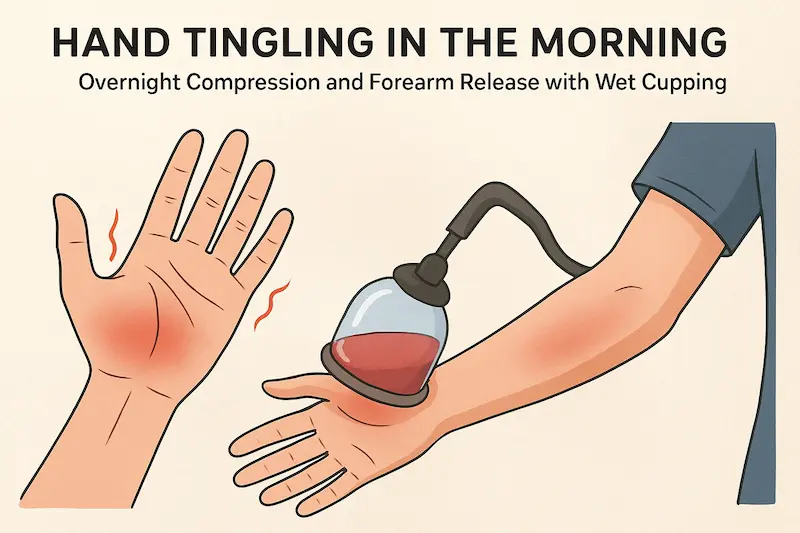
1. Forearm Stiffness at the Radial Side (Brachioradialis Region)
The upper forearm, particularly near the brachioradialis, plays a major role in wrist positioning during sleep. When this region becomes tight from daytime computer use or gripping tasks, the superficial radial nerve loses mobility. Sleeping with the wrist bent or the forearm tucked can increase the pressure, leading to tingling upon waking.
Typical symptoms:
- Tingling on the thumb side
- Light numbness on the back of the hand
- Forearm tightness when making a fist
- Sharp “electric” sensations when extending the wrist
Morning tingling usually means this nerve got “stuck” overnight and needs decompression.
2. Mid-Forearm Congestion Along the Extensor Line
Typing and repetitive wrist movements cause the extensor digitorum and ECU to accumulate micro-tension. During sleep, these already-tight tissues become even more compressed. Because several sensory nerves run beneath this muscular “tunnel,” any extra nighttime pressure can trigger tingling in the fingers.
Common signs:
- Heaviness in the wrist when waking
- Diffuse tingling across 2–4 fingers
- Stiffness when flexing or extending the wrist
This region responds especially well to negative-pressure therapy.
3. Tight Wrist Position While Sleeping (Extensor Retinaculum Compression)
The dorsal wrist band—the extensor retinaculum—is a firm, non-stretching structure. If the wrist stays flexed or curled beneath a pillow, the pressure increases dramatically. Overnight, this can compress the nerve branches that supply the palm and fingers.
Symptoms include:
- Tingling that fades after shaking the hand
- Morning weakness or “slow fingers”
- A tight band sensation at the wrist
This is one of the main reasons hand tingling disappears after a few minutes of movement.
4. Circulation Restriction Across the Dorsal Hand
Blood flow naturally slows during sleep. If the dorsal hand already has fascial tightness from daytime strain, the reduced circulation amplifies the “pins and needles” effect.
This is especially common in:
- People who sleep on their hands
- Side sleepers with arms tucked
- Those who use phones extensively before bed
The lumbrical region becomes congested, causing tingling at the base of the fingers.
How Wet Cupping Helps Reduce Morning Hand Tingling
Wet cupping relieves morning hand tingling by targeting the exact tissues that became compressed overnight. Instead of stretching or massage—which may not reach deep fascial layers—wet cupping uses decompression to lift and separate tight structures.
Here’s how it works:
1. Decompressing Nerve Pathways
The negative pressure reduces mechanical stress around the superficial radial nerve and other sensory branches. Once these pathways regain space, nerve flow improves and tingling decreases.
2. Improving Microcirculation After Overnight Stagnation
During sleep, blood flow slows naturally. Wet cupping restores circulation quickly, providing oxygen and nutrients to irritated nerve endings. Improved circulation = faster recovery from overnight compression.
3. Releasing Deep Fascia That Pulls on the Wrist and Fingers
Typing, gripping, and scrolling create layers of invisible stiffness. Overnight, these layers restrict even more. Wet cupping releases the stiffness at the source, allowing the tissues to glide smoothly again.
4. Reducing Wrist Band Tension
When applied to the correct zones around the dorsal wrist, wet cupping reduces the pressure under the extensor retinaculum. This is one of the most effective ways to ease morning “pins and needles.”
5. Restoring Finger Mobility After Sleep
After decompression, the dorsal hand feels lighter and finger movement becomes easier. Tingling fades as nerve conduction normalizes.
Best Habits to Prevent Morning Tingling
- Avoid sleeping with wrists bent
- Keep elbows slightly open instead of tucked
- Hydrate 1–1.5 liters after cupping
- Perform gentle wrist circles before bed
- Reduce late-night gripping or phone use
Conclusion
Morning hand tingling is not always a sign of nerve disease — in most cases, it’s a mechanical problem caused by hours of overnight compression in the wrist, forearm, or elbow. When circulation slows and pressure builds around the median or ulnar nerve, the fingers “wake up” feeling numb, electric, or buzzing. Hydration, gentle forearm mobility, and pressure-free sleeping positions support recovery, but when tissue congestion becomes chronic, wet cupping provides an additional release.
By improving micro-circulation, reducing fascial stiffness, and decompressing the nerve pathway around the forearm and upper back, wet cupping helps break the cycle of compression → stagnation → morning tingling. When combined with daily ergonomic habits, this approach can restore hand comfort, reduce flare-ups, and help your mornings feel normal again.
Hand tingling in the morning often comes from overnight compression along the forearm and wrist. Wet cupping helps decompress these pathways, restore circulation, and ease the buzzing sensations when you wake up. To learn the precise, safe point system, check it out in our upcoming e-book and explore how to practice wet cupping safely at home inside our free Natural Reset: modern wet cupping made simple book.”