
Many people feel chest tightness and immediately worry about the heart. But in a huge number of cases, the sensation doesn’t come from the heart at all. Instead, it comes from tension patterns around the upper back, rib cage, breathing muscles, and the shoulder girdle that create a pressure-like feeling across the chest.
This non-cardiac chest tightness is surprisingly common—especially in people with heavy stress, long sitting hours, shallow breathing habits, and micro-inflammation around the upper back. Here’s how it works and what you can do to ease it naturally.
Add Your Heading Text HWhy Chest Tightness Can Happen Even When the Heart Is Fineere
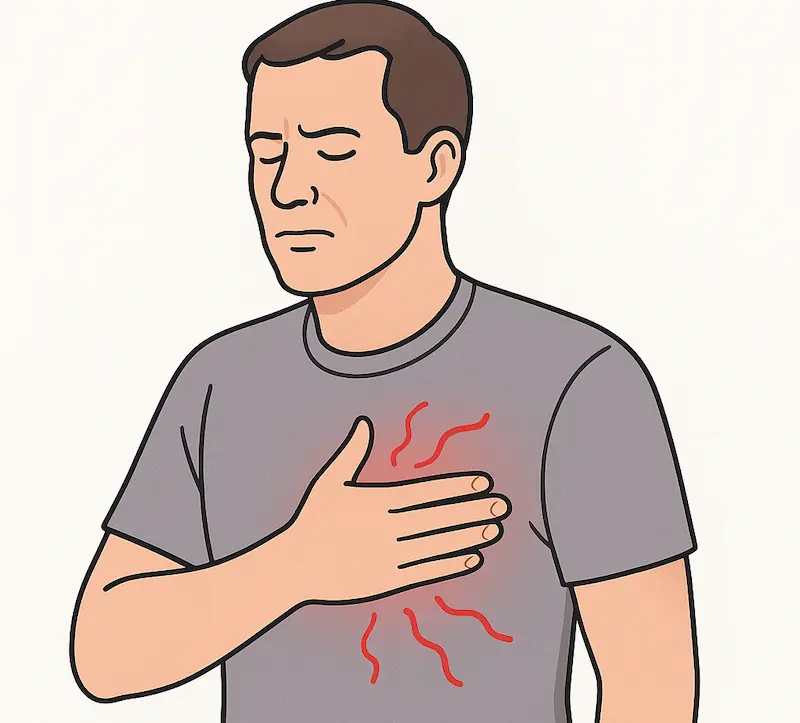
When the heart is not the source, the tightness often comes from:
Rib cage stiffness
The ribs expand and rotate every time you breathe. If the muscles between them become tight, you can feel pressure in the front of the chest.
Upper back micro-inflammation
Small pockets of stagnation around the upper spine—especially around the area that stabilizes your rib cage—can disrupt normal movement and create a “band-like” tightness across the front.
Overactive upper chest breathing
Stress shifts the body into shallow breathing. This activates the upper chest and neck muscles, causing sensations like:
- hard to take a full breath
- tight band across sternum
- chest feels heavy or squeezed
Emotional stress patterns
Stress can tighten the diaphragm and rib cage without you realizing it, making the chest feel constricted even when physically nothing is wrong.
The Upper-Back Connection: The Core of Non-Cardiac Chest Tightness
Most people are surprised that the feeling in the front of the body actually starts from the back.
Here’s the overlooked mechanism:
- The upper back stabilizes the ribs.
- When this area becomes stiff or inflamed, the ribs stop moving smoothly.
- When the ribs lose mobility, the front of the chest compensates.
- The muscles in the front tighten to “hold everything together,” creating pressure or heaviness.
This is why many people feel:
- tight chest + tight mid-upper back
- chest pressure when sitting
- relief when stretching the back
And this is also why many cases improve when the rear tension is addressed first, not the front
Breathing Muscles Often Cause Chest Pressure
The diaphragm, intercostals (rib muscles), and small chest muscles can all mimic cardiac symptoms when they’re tight.
Signs the tightness is muscular—not cardiac:
- improves when stretching
- worse with long sitting
- triggered by stress or anxiety
- feels like you can’t “complete a breath”
- disappears when lying on the side
If you can reproduce the sensation by pressing your chest, rib cage, or upper-back muscles, it’s usually a mechanical (not cardiac) issue.
How Wet Cupping Helps the Upper-Back Mechanism
Wet cupping isn’t a replacement for medical care—but for non-cardiac chest tightness caused by muscular and fascial tension, many people report relief because of how it affects the upper back.
How it helps:
- reduces stagnant tension around the upper spine
- improves circulation in the rib-supporting muscles
- helps restore fluid glide between tissues
- triggers deeper breathing by relaxing the rib cage
- improves parasympathetic activation (calming response)
When the upper-back “traffic jam” eases, the front of the chest naturally relaxes without forcing it.
Simple Daily Techniques to Reduce Chest Tightness
You can support recovery with:
- Gentle rib-expansion breathing. Place hands on the sides of your ribs.
Breathe into your palms for 4 seconds → exhale for 6 seconds. This retrains the diaphragm and reduces upper-chest tension. - Upper-back mobility. Cat–cow, thoracic rotations, and wall extensions help restore rib cage glide.
- Hydration for fascia fluidity. Many people with chronic chest and rib tightness are mildly dehydrated, which reduces fascia elasticity.
- Break up long sitting. Every 30 minutes, do; shoulder rolls, rib mobilization, deep breath + back extension
The goal isn’t stretching harder—it’s restoring smooth rib and spine movement.
When to Seek Medical Evaluation
Although non-cardiac chest tightness is common, seek medical care if you experience:
- sudden severe chest pain
- pain spreading to jaw or left arm
- dizziness or fainting
- shortness of breath unrelated to anxiety
- chest pressure during exercise
If a doctor clears your heart, the upper-back + rib cage mechanism is the next most likely source.
If your chest tightness keeps returning even after doctor clearance, learn the simple upper-back wet cupping approach that helps restore rib mobility, improve breathing depth, and reduce daily pressure sensations — and while you’re at it, explore wet cupping for heart-health support to ease chest discomfort from two angles at once.