
When Shoulder Tension Goes Beyond Muscles
Many people associate shoulder tension with posture or overuse, but the impact goes far deeper. Chronic tightness in the shoulders can influence the Hypothalamic-Pituitary-Adrenal (HPA) axis, the body’s central stress regulation system.
Over time, this tension may subtly elevate cortisol levels, contributing to fatigue, irritability, and anxiety, even in individuals who sleep well and maintain an active lifestyle. While traditional remedies focus on stretching or massage, wet cupping has emerged as a supportive practice that can reduce shoulder tension and promote physiological balance through its effects on microcirculation and the nervous system.
This article explores the physiological link between shoulder tension and stress hormones and explains how wet cupping can safely support HPA axis balance.
Understanding the Shoulder–HPA Axis Connection
The Role of Shoulder Muscles in Stress Physiology
The upper trapezius, levator scapulae, and surrounding muscles are key postural stabilizers. Chronic tension in these areas can:
- restrict local blood flow
- compress small sensory nerves
- trigger a persistent low-level stress response
When these muscles are tense, sensory feedback to the brain signals ongoing discomfort, prompting subtle activation of the HPA axis.
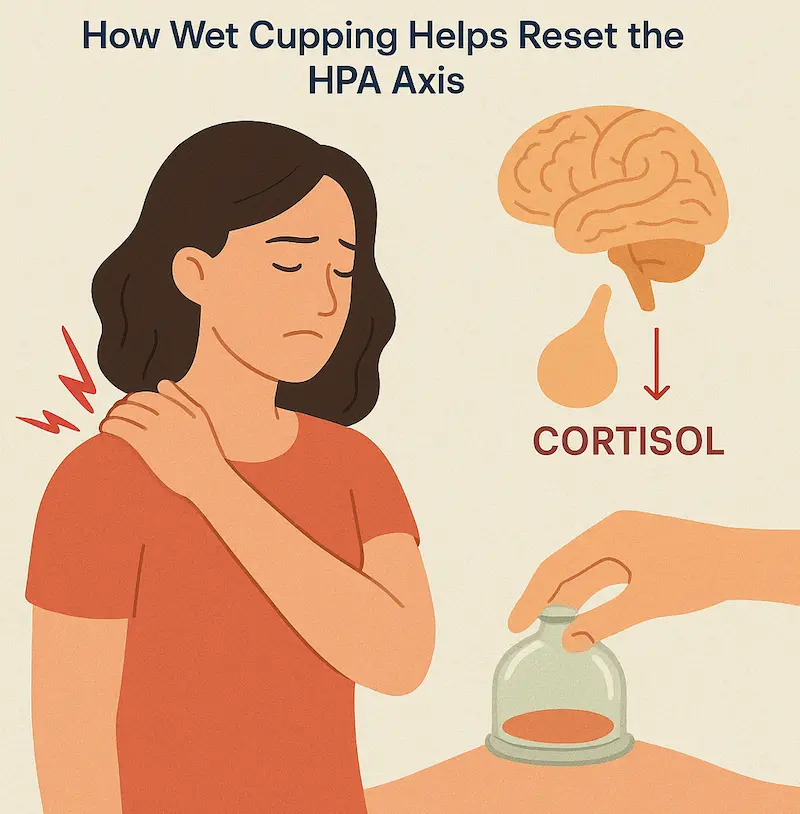
Cortisol and Chronic Low-Level Stress
The HPA axis regulates cortisol, a hormone essential for:
- metabolism
- immune response
- alertness and stress adaptation
Persistent shoulder tension can lead to repeated mild HPA activation. While not immediately harmful, sustained low-level cortisol elevation can cause:
- daytime fatigue
- mild anxiety or nervousness
- difficulty concentrating
- reduced resilience to new stressors
This is a physiological explanation for why people feel “drained” or tense even when external stressors are minimal.
Muscle Tension as a Stress Feedback Loop
Tense shoulder muscles create a feedback loop:
- Muscle tightness signals stress
- HPA axis releases cortisol
- Cortisol subtly primes muscles to remain tense
- Cycle repeats, increasing physiological fatigue
This is why tension in shoulders is not merely a musculoskeletal issue—it affects systemic stress regulation.
How Wet Cupping Supports HPA Axis Balance
Wet cupping is not a medical treatment for hormonal disorders. However, it can be incorporated safely as a supportive physiological practice to reduce muscle tension and gently influence the HPA axis.
Reducing Local Muscle Tension
By creating gentle negative pressure over the upper trapezius and shoulder line, wet cupping:
- relaxes tight muscle fibers
- improves tissue pliability
- reduces mechanical stress on sensory nerves
This decreased tension lowers continuous stress signals to the brain, which helps HPA activity normalize.
Improving Microcirculation
Cupping draws blood to the superficial layers of the skin and muscle, promoting:
- enhanced local blood flow
- better oxygen and nutrient delivery
- removal of metabolic byproducts
Improved circulation supports muscle recovery and reduces physical stress, indirectly reducing HPA overactivation
Supporting Nervous System Balance
Relaxed muscles + improved circulation communicate through sensory pathways to the central nervous system:
- parasympathetic activation increases
- sympathetic overdrive decreases
- subtle recalibration of HPA axis occurs
This doesn’t replace healthy sleep or stress management but supports a calmer physiological baseline.
Practical Tips to Complement Wet Cupping
To maximize benefits, combine wet cupping with simple daily habits:
- Posture Awareness
- Sit with shoulders relaxed and back supported
- Avoid forward-head tilt
- Micro-adjust every 30–60 minutes
- Gentle Stretching
- Shoulder rolls, scapular retractions, and neck mobility exercises
- 1–2 minutes per session can maintain pliability
- Deep Breathing
- Slow diaphragmatic breaths reduce sympathetic tension
- Encourages parasympathetic dominance, supporting HPA balance
- Hydration and Micro-Breaks
- Adequate water intake maintains circulation
- Standing or moving briefly every hour reduces tension accumulation
When paired with wet cupping, these habits enhance comfort, circulation, and physiological resilience.
Takeaway
Chronic shoulder tension is more than a postural problem—it can subtly dysregulate the HPA axis, contributing to fatigue, mild anxiety, and stress vulnerability.
Wet cupping offers a safe, supportive approach to:
- relieve muscle tightness
- improve local microcirculation
- help rebalance autonomic and stress response systems
While it is not a replacement for sleep, healthy lifestyle, or medical care, wet cupping can complement a holistic stress management routine, promoting daily comfort, better focus, and resilience to physiological stress.